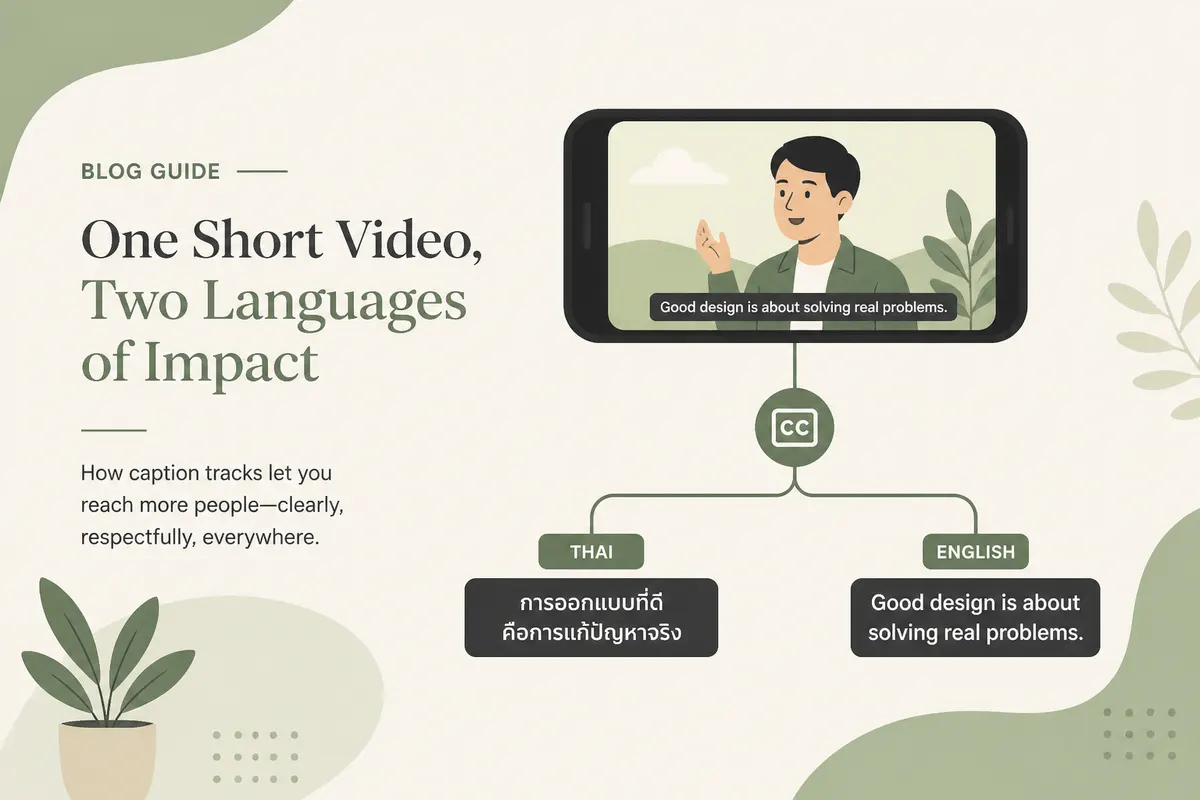
How Words Are Recognized in English Speech-to-Text Systems

Eric King
Author
Speech-to-Text (STT), also known as Automatic Speech Recognition (ASR), is the technology that converts spoken language into written text. At first glance, recognizing words from speech may seem straightforward: people speak, and the system writes down what it hears. In reality, this process is complex, especially for English. This article explains how words are recognized in STT systems, with a focus on general word recognition, the unique characteristics of English, the role of context, and the technical implementation behind modern systems.
1. General Word Recognition in Speech-to-Text
At a high level, word recognition in STT systems follows a common pipeline across languages:
-
Audio Capture Speech is recorded as a continuous audio signal. This signal contains not only linguistic information but also background noise, speaker characteristics, and environmental effects.
-
Feature Extraction The raw waveform is transformed into features that better represent speech sounds. Common features include Mel-Frequency Cepstral Coefficients (MFCCs) or log-Mel spectrograms. These features capture how energy is distributed across frequencies over time, closely matching how humans perceive sound.
-
Acoustic Modeling The system learns the relationship between audio features and basic sound units (such as phonemes or subword units). This step answers the question: What sounds are being spoken?
-
Lexical Mapping Recognized sound units are mapped to words using a pronunciation dictionary or learned subword representations.
-
Decoding Finally, the system searches for the most likely word sequence given the audio and the language rules it has learned.
This general process applies to most languages, but English introduces several unique challenges.
2. The Special Nature of English Compared to Other Languages
English differs from many other languages in ways that significantly affect speech recognition.
2.1 Irregular Spelling and Pronunciation
Unlike languages such as Spanish or Japanese, English has a weak correspondence between spelling and pronunciation. For example:
- though, through, thought, and tough all look similar but sound very different.
- The same sound can be spelled in many ways (see, sea, scene), and the same spelling can produce different sounds (read in present vs. past tense).
This irregularity makes it difficult to rely solely on pronunciation rules, increasing the importance of learned patterns and context.
2.2 Homophones and Near-Homophones
English contains many homophones—words that sound the same but have different meanings and spellings:
- to / too / two
- there / their / they're
In speech, these words are acoustically identical. The system must rely on surrounding words and grammatical structure to choose the correct one.
2.3 Stress, Reduction, and Connected Speech
Spoken English often differs greatly from written English:
- Function words are reduced (going to → gonna, want to → wanna).
- Sounds blend together across word boundaries (next please → /neks pliːz/).
Compared to tonal languages like Mandarin, where tone plays a key lexical role, English relies heavily on stress and rhythm, which adds another layer of complexity.
3. Using Context to Assist Word Recognition
Because English speech is ambiguous at the sound level, context is essential for accurate word recognition.
3.1 Local Context (Nearby Words)
Modern STT systems do not recognize words in isolation. Instead, they consider the probability of word sequences:
- I want to ___ a car → buy is far more likely than by or bye.
This local context helps disambiguate homophones and unclear pronunciations.
3.2 Grammatical and Syntactic Context
Grammar provides strong constraints. For example:
- She ___ going home → is is more likely than are.
Language models learn these patterns from large text corpora, allowing the system to prefer grammatically valid sentences.
3.3 Semantic and Topic Context
Higher-level meaning also matters. If the topic is technology, words like server, model, or API become more likely. Some systems adapt dynamically by:
- Using domain-specific language models
- Incorporating user history or application context (with privacy safeguards)
3.4 Long-Range Context
Advanced models can consider entire sentences or even paragraphs, helping resolve ambiguities that cannot be solved locally. For example, earlier sentences may establish tense, subject, or topic that influences later word choices.
4. Technical Implementation of Word Recognition
4.1 Traditional Systems: HMM + GMM
Earlier STT systems used a combination of:
- Hidden Markov Models (HMMs) to model time sequences
- Gaussian Mixture Models (GMMs) to model acoustic feature distributions
These systems relied heavily on hand-designed components such as phoneme dictionaries and explicit language models.
4.2 Deep Learning-Based Acoustic Models
Modern systems replace GMMs with deep neural networks (DNNs), including:
- Convolutional Neural Networks (CNNs)
- Recurrent Neural Networks (RNNs)
- Transformers
These models learn complex mappings from audio features directly to phonemes or subword units, significantly improving robustness to noise and speaker variation.
4.3 End-to-End Models
End-to-end architectures, such as CTC (Connectionist Temporal Classification), RNN-Transducer, and attention-based encoder–decoder models, simplify the pipeline by:
- Mapping audio directly to characters, subwords, or words
- Reducing reliance on handcrafted pronunciation dictionaries
Subword units (like Byte Pair Encoding or WordPiece) are especially useful for English, as they handle rare words and spelling variations more effectively.
4.4 Decoding and Beam Search
During inference, the system uses beam search to explore multiple possible word sequences and select the most probable one based on:
- Acoustic likelihood
- Language model probability
This balancing act is crucial for resolving ambiguities in English speech.
5. Additional Factors and Future Directions
5.1 Speaker and Accent Variability
English is spoken with a wide range of accents (American, British, Indian, Singaporean, etc.). Modern STT systems address this by training on diverse datasets and using speaker-adaptive techniques.
5.2 Noise and Real-World Conditions
Background noise, overlapping speech, and microphone quality all affect recognition. Techniques such as speech enhancement and noise-robust training improve performance in real-world scenarios.
5.3 Context-Aware and Multimodal STT
Future systems increasingly combine speech with other signals, such as:
- Text already on the screen
- User interactions
- Visual cues
This multimodal context can further improve word recognition accuracy.
Conclusion
Word recognition in English Speech-to-Text systems is far more than matching sounds to words. It requires handling irregular pronunciation, ambiguity, and connected speech, while leveraging context at multiple levels. Modern deep learning and end-to-end models have dramatically improved accuracy, but context-aware understanding remains a key factor—especially for English. As models continue to evolve, STT systems will become more accurate, more adaptive, and closer to human-level understanding of spoken language.