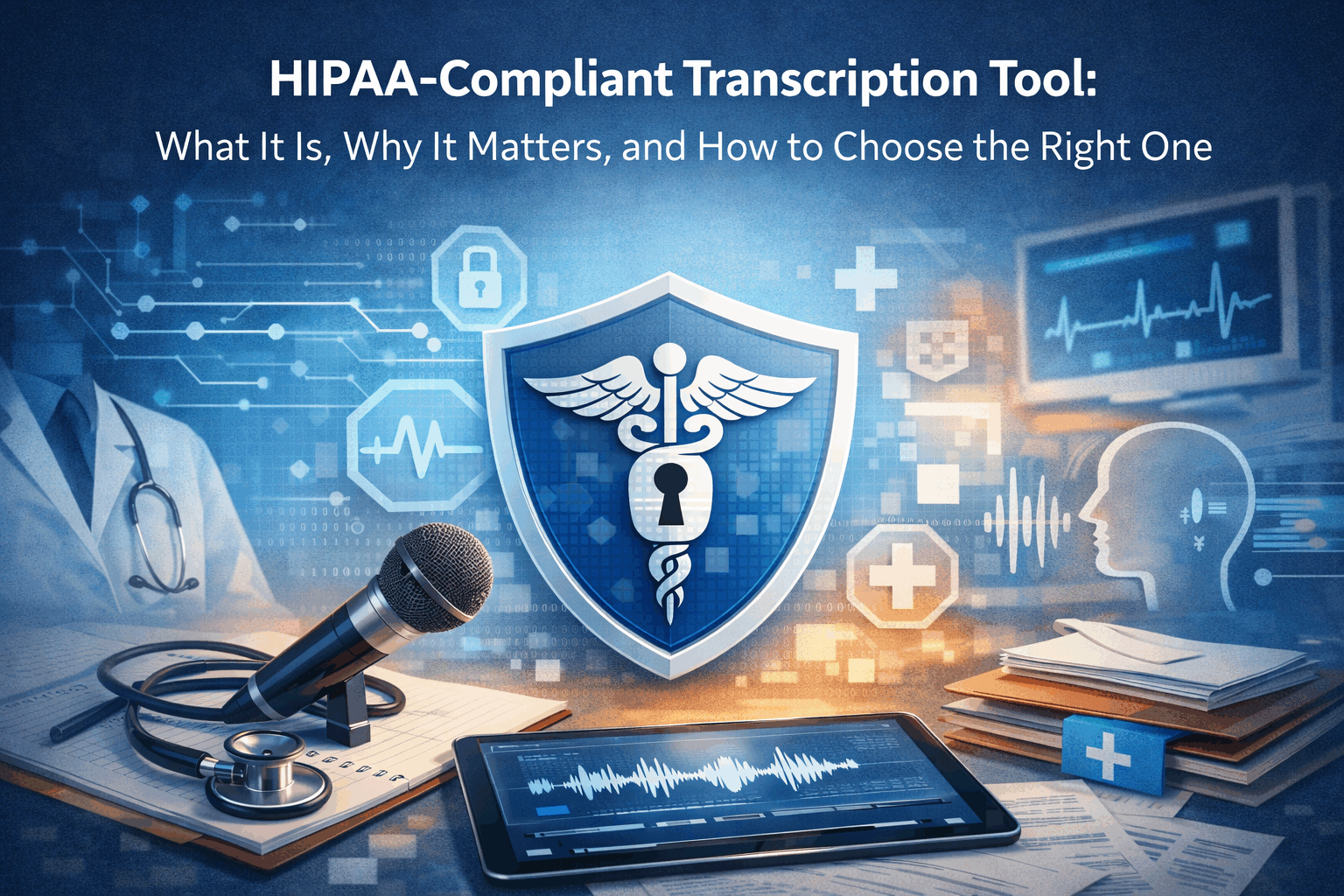
HIPAA-Compliant Transcription Tool: What It Is, Why It Matters, and How to Choose the Right One

Eric King
Author
Introduction
If you work in healthcare, choosing a HIPAA-compliant transcription tool is not optional — it's essential. Medical audio often contains protected health information (PHI), and using a non-compliant speech-to-text tool can lead to serious legal and financial consequences, including fines up to $1.5 million per violation.
This comprehensive guide explains what a HIPAA-compliant transcription tool is, how it works, why compliance matters, and how to choose the right solution for healthcare and medical use cases. Whether you're a healthcare provider, medical transcriptionist, or healthcare administrator, this guide will help you make informed decisions about secure transcription.
Quick Summary:
- HIPAA compliance is mandatory for any tool processing medical audio containing PHI
- Key requirements: BAA agreement, encryption, access controls, audit logs
- Regular transcription tools are not HIPAA compliant and pose significant legal risks
- Choose carefully: Verify BAA availability, encryption, and compliance certifications
What Is a HIPAA-Compliant Transcription Tool?
A HIPAA-compliant transcription tool is a speech-to-text or audio transcription system designed to securely process medical audio while complying with the Health Insurance Portability and Accountability Act (HIPAA). HIPAA is a U.S. federal law that protects patient health information and sets standards for healthcare data security and privacy.
In simple terms, it converts speech into text without exposing sensitive patient data, ensuring that protected health information (PHI) remains secure throughout the transcription process.
What Is Protected Health Information (PHI)?
A HIPAA-compliant tool must protect all Protected Health Information (PHI), which includes:
- Patient names: Full names, nicknames, or any identifying names
- Medical conditions: Diagnoses, symptoms, medical history
- Diagnoses: Medical diagnoses and test results
- Treatment details: Medications, procedures, treatment plans
- Demographic information: Dates of birth, addresses, phone numbers, email addresses
- Medical record numbers: Patient IDs, account numbers
- Biometric identifiers: Fingerprints, voiceprints, facial recognition
- Any identifiable healthcare information: Any information that could identify a patient
Key Characteristics of HIPAA-Compliant Tools:
- ✅ Business Associate Agreement (BAA): Signed agreement with the service provider
- ✅ Encryption: Data encrypted in transit and at rest
- ✅ Access controls: Role-based permissions and authentication
- ✅ Audit logs: Complete logging of all data access and actions
- ✅ Data retention controls: Ability to delete data and control storage duration
- ✅ Compliance certifications: Third-party audits and certifications
Why HIPAA Compliance Matters in Speech-to-Text
Using a regular transcription tool for medical audio can be extremely risky and can result in severe legal and financial consequences. Understanding these risks is crucial for healthcare organizations.
Risks of Using Non-Compliant Tools:
Without HIPAA compliance, you face:
- ❌ Audio may be stored unencrypted: Patient data vulnerable to breaches
- ❌ Data could be used for model training: PHI potentially exposed to third parties
- ❌ Access logs may not exist: No way to track who accessed patient data
- ❌ No legal protection if data is leaked: Your organization is fully liable
- ❌ No Business Associate Agreement: No contractual protection or shared responsibility
- ❌ Potential HIPAA violations: Fines up to $1.5 million per violation category per year
- ❌ Legal liability: Lawsuits, regulatory investigations, and reputational damage
- ❌ Loss of patient trust: Breaches damage patient confidence and relationships
Benefits of HIPAA-Compliant Tools:
With HIPAA compliance:
- ✅ Patient privacy is protected: PHI is secured throughout the entire process
- ✅ Healthcare providers stay legally compliant: Meet regulatory requirements
- ✅ Trust and security are maintained: Patients and partners trust your data handling
- ✅ Data handling follows strict regulations: Compliant with federal law
- ✅ Legal protection: BAA provides contractual protection and shared responsibility
- ✅ Audit trail: Complete logs for compliance audits and investigations
- ✅ Risk mitigation: Reduces legal and financial exposure
- ✅ Professional reputation: Demonstrates commitment to patient privacy
The Cost of Non-Compliance:
HIPAA violations can result in:
- Civil penalties: $100 to $50,000 per violation, up to $1.5 million per year per violation category
- Criminal penalties: Up to $250,000 and 10 years in prison for willful violations
- Reputational damage: Loss of patient trust and business
- Legal costs: Investigations, lawsuits, and settlements
- Operational disruption: Remediation efforts and system changes
👉 HIPAA compliance is about risk prevention, not just accuracy. It's a legal requirement that protects patients, your organization, and your reputation.
How Does a HIPAA-Compliant Transcription Tool Work?
Although the user experience looks simple, the system behind it is carefully designed with multiple layers of security and compliance controls. Understanding how these systems work helps you evaluate potential solutions.
Step 1: Secure Audio Upload
Security measures:
- ✅ Audio is encrypted during upload: TLS/HTTPS encryption ensures data cannot be intercepted
- ✅ Access is restricted to authorized users only: Authentication and authorization required
- ✅ Secure file transfer: Encrypted channels prevent man-in-the-middle attacks
- ✅ File validation: Checks for malware and validates file formats
- ✅ Upload logging: All uploads are logged with user identification and timestamps
What this means: Your audio files are protected from the moment they leave your device until they reach the secure server.
Step 2: Protected Speech Recognition
Processing security:
- ✅ Transcription runs in a secure environment: Isolated processing environment prevents data leakage
- ✅ Data is not reused for training without consent: PHI is never used to train models without explicit permission
- ✅ Processing follows strict isolation rules: Each transcription job is isolated from others
- ✅ No data sharing: PHI is never shared with third parties or used for analytics
- ✅ Secure processing infrastructure: Servers meet security standards (SOC 2, ISO 27001)
What this means: Your patient data is processed securely and never used for purposes other than transcription.
Step 3: Encrypted Storage & Access Control
Storage and access security:
- ✅ Transcripts are encrypted at rest: Data is encrypted when stored on servers
- ✅ Role-based access limits who can view data: Only authorized users can access transcripts
- ✅ All actions are logged for auditing: Complete audit trail of all data access
- ✅ Multi-factor authentication: Additional security layer for user access
- ✅ Data retention controls: You control how long data is stored
- ✅ Automatic deletion: Data can be automatically deleted after specified periods
What this means: Even if someone gains access to storage systems, encrypted data remains protected, and all access is tracked.
Step 4: Compliance & Agreements
Legal and compliance framework:
- ✅ Provider signs a Business Associate Agreement (BAA): Legal contract ensuring HIPAA compliance
- ✅ Ensures shared responsibility for PHI protection: Both parties are responsible for security
- ✅ Compliance certifications: Third-party audits (SOC 2, HITRUST, etc.)
- ✅ Regular security assessments: Ongoing evaluation of security controls
- ✅ Incident response procedures: Defined processes for handling security incidents
What this means: You have legal protection and shared responsibility for PHI protection, with third-party verification of security practices.
The Complete Security Flow:
1. Audio Upload → Encrypted (TLS/HTTPS) → Secure Server
2. Processing → Isolated Environment → No Data Reuse
3. Storage → Encrypted at Rest → Access Controlled
4. Access → Role-Based → Fully Audited
5. Compliance → BAA Signed → Certifications Verified
Key Takeaway: HIPAA-compliant transcription involves multiple layers of security at every stage, from upload to storage to access, ensuring PHI is protected throughout the entire process.
Common Use Cases for HIPAA-Compliant Transcription
HIPAA-compliant speech-to-text tools are widely used across healthcare settings, enabling healthcare providers to efficiently document patient interactions while maintaining compliance. Here are the most common use cases:
Clinical Documentation
- Doctor–patient conversations: Transcribe consultations and medical discussions
- Clinical notes and dictation: Convert voice notes to structured medical records
- Medical interviews: Document patient interviews and medical histories
- Surgical notes: Transcribe surgical procedures and post-operative notes
Mental Health and Therapy
- Therapy and counseling sessions: Document therapy sessions while maintaining patient privacy
- Psychiatric evaluations: Transcribe mental health assessments
- Group therapy sessions: Document group therapy with proper speaker identification
Telemedicine and Remote Care
- Telemedicine recordings: Transcribe remote consultations and virtual visits
- Remote patient monitoring: Document patient-reported symptoms and updates
- Telehealth follow-ups: Convert follow-up calls to medical records
Medical Research and Documentation
- Medical research documentation: Transcribe research interviews and data collection
- Clinical trial documentation: Document trial participant interactions
- Medical education: Transcribe lectures and educational content (with proper consent)
Administrative and Operational
- Medical billing: Transcribe billing-related conversations
- Insurance documentation: Document insurance-related discussions
- Quality assurance: Transcribe quality review meetings and discussions
Specialized Healthcare Settings
- Hospital rounds: Document patient rounds and team discussions
- Emergency department: Transcribe emergency consultations
- Nursing documentation: Convert nursing notes to digital records
- Pharmacy consultations: Document medication counseling sessions
Important Note: All these use cases require HIPAA-compliant tools because they involve PHI. Using non-compliant tools for any of these purposes violates HIPAA regulations and puts your organization at risk.
How to Choose a HIPAA-Compliant Transcription Tool
Not all "medical transcription" tools are truly HIPAA compliant. Many tools claim to be secure, but only some meet the strict requirements of HIPAA. Use this comprehensive checklist when evaluating potential solutions.
1. Does It Offer a Business Associate Agreement (BAA)?
This is the most critical requirement.
- ✅ A Business Associate Agreement is mandatory: Without a BAA, the tool is NOT HIPAA compliant
- ✅ BAA must be signed: Verbal agreements or promises are not sufficient
- ✅ BAA should be comprehensive: Covers all aspects of PHI handling and security
- ✅ Review BAA terms: Ensure it covers your specific use case and requirements
Red flags:
- ❌ Provider refuses to sign a BAA
- ❌ Provider says "we're HIPAA compliant" but won't sign a BAA
- ❌ BAA is vague or doesn't cover key security requirements
Action: If a provider does not offer a BAA, it is NOT HIPAA compliant. Do not use it for medical transcription.
2. Is Data Fully Encrypted?
Both encryption types are required:
- ✅ Encryption in transit: Data encrypted during upload and download (TLS 1.2+)
- ✅ Encryption at rest: Data encrypted when stored on servers (AES-256 or equivalent)
- ✅ Key management: Proper encryption key management and rotation
- ✅ Certificate validation: Valid SSL/TLS certificates for secure connections
What to verify:
- Ask about encryption standards (should be industry-standard like AES-256)
- Verify TLS/HTTPS is used for all data transfers
- Confirm encryption at rest is implemented
- Check if encryption keys are managed securely
Red flags:
- ❌ No encryption at rest
- ❌ Weak encryption standards
- ❌ No information about encryption provided
3. Can You Control Data Retention?
You must have control over data lifecycle:
- ✅ Delete audio and transcripts: Ability to permanently delete data
- ✅ Control storage duration: Set retention periods and automatic deletion
- ✅ Prevent data reuse: Ensure data is not used for training or other purposes
- ✅ Export capabilities: Ability to export and backup your data
- ✅ Data portability: Move data to other systems if needed
What to verify:
- Can you delete data immediately?
- Are there automatic deletion options?
- Is data retained longer than necessary?
- Can you export data in standard formats?
Red flags:
- ❌ Cannot delete data
- ❌ Data retained indefinitely
- ❌ No control over data lifecycle
4. Is Access Auditable?
Complete audit trails are essential:
- ✅ User access logs: Who accessed what data and when
- ✅ Role-based permissions: Different access levels for different users
- ✅ Activity tracking: All actions logged (view, edit, delete, download)
- ✅ Audit reports: Ability to generate compliance reports
- ✅ Alert systems: Notifications for suspicious access patterns
What to verify:
- Are all access attempts logged?
- Can you see who accessed specific transcripts?
- Are audit logs tamper-proof?
- Can you export audit logs for compliance reviews?
Red flags:
- ❌ No access logs
- ❌ Cannot track who accessed data
- ❌ No role-based access control
5. Does It Fit Your Workflow?
Consider your specific needs:
- ✅ Batch vs real-time transcription: Does it support your processing needs?
- ✅ Language support: Does it support languages you need?
- ✅ Integration with EHR systems: Can it integrate with your existing systems?
- ✅ File format support: Does it support your audio formats?
- ✅ Accuracy requirements: Does it meet your accuracy needs?
- ✅ Processing speed: Does it meet your turnaround time requirements?
Additional considerations:
- Scalability: Can it handle your volume?
- User interface: Is it easy for your team to use?
- Support: Is support available when you need it?
- Cost: Does it fit your budget?
- Training: Is training available for your team?
6. Additional Security Features to Look For:
- ✅ Multi-factor authentication (MFA): Additional security layer
- ✅ Single sign-on (SSO): Integration with your identity provider
- ✅ IP whitelisting: Restrict access to specific IP addresses
- ✅ Session management: Automatic logout and session timeouts
- ✅ Compliance certifications: SOC 2, HITRUST, ISO 27001, etc.
- ✅ Regular security audits: Third-party security assessments
- ✅ Incident response: Defined procedures for security incidents
- ✅ Data breach notification: Procedures for notifying you of breaches
Evaluation Checklist Summary:
| Requirement | Status | Notes |
|---|---|---|
| BAA Available | ⬜ | Must be signed |
| Encryption in Transit | ⬜ | TLS 1.2+ required |
| Encryption at Rest | ⬜ | AES-256 or equivalent |
| Data Retention Control | ⬜ | Must be able to delete |
| Access Logging | ⬜ | Complete audit trail |
| Role-Based Access | ⬜ | Different permission levels |
| Workflow Fit | ⬜ | Meets your needs |
| Compliance Certifications | ⬜ | SOC 2, HITRUST, etc. |
| Support Available | ⬜ | When you need it |
| Cost Reasonable | ⬜ | Fits budget |
Remember: If any critical requirement (BAA, encryption, access control) is missing, the tool is NOT HIPAA compliant and should not be used for medical transcription.
HIPAA-Compliant Transcription vs Regular Speech-to-Text
Understanding the differences between HIPAA-compliant tools and regular speech-to-text services is crucial for making the right choice. Here's a detailed comparison:
| Feature | HIPAA-Compliant Tool | Regular Tool |
|---|---|---|
| Handles PHI | ✅ Yes (designed for it) | ❌ No (not designed for PHI) |
| Encryption | ✅ Required (in transit & at rest) | ⚠️ Optional (may not be encrypted) |
| BAA | ✅ Required (must be signed) | ❌ Not available |
| Legal compliance | ✅ Yes (HIPAA compliant) | ❌ Risky (not compliant) |
| Healthcare use | ✅ Safe (designed for healthcare) | ❌ Not recommended (legal risk) |
| Data reuse | ✅ Controlled (no training without consent) | ⚠️ May be used for training |
| Access controls | ✅ Required (role-based, audited) | ⚠️ Basic (may not be sufficient) |
| Audit logs | ✅ Required (complete logging) | ⚠️ Limited or none |
| Data retention | ✅ Controlled (you control duration) | ⚠️ May retain indefinitely |
| Compliance certifications | ✅ Yes (SOC 2, HITRUST, etc.) | ❌ No |
| Legal protection | ✅ Yes (BAA provides protection) | ❌ No (you're fully liable) |
| Cost | ⚠️ May be higher | ✅ Often lower |
| Setup complexity | ⚠️ May require more setup | ✅ Usually simpler |
Key Differences Explained:
1. Legal Protection:
- HIPAA-Compliant: BAA provides legal protection and shared responsibility
- Regular Tool: No legal protection; you're fully liable for any breaches
2. Data Security:
- HIPAA-Compliant: Multiple layers of security, encryption, access controls
- Regular Tool: Basic security; may not meet healthcare standards
3. Compliance:
- HIPAA-Compliant: Designed to meet HIPAA requirements
- Regular Tool: Not designed for healthcare; using it violates HIPAA
4. Data Usage:
- HIPAA-Compliant: PHI is never used for training without explicit consent
- Regular Tool: Your data may be used to train models
5. Auditability:
- HIPAA-Compliant: Complete audit trails for compliance
- Regular Tool: Limited or no audit capabilities
Bottom Line: Regular speech-to-text tools are NOT suitable for healthcare use. Using them for medical transcription violates HIPAA and puts your organization at significant legal and financial risk.
Is Open-Source Speech-to-Text (Like Whisper) HIPAA Compliant?
This is a common question, and the answer depends on how you use open-source models like OpenAI Whisper.
Open-Source Models CAN Be HIPAA Compliant If:
✅ Self-hosted: You host the model on your own infrastructure or compliant cloud
✅ Properly secured: Infrastructure meets HIPAA security requirements
✅ Used in an environment with strict access control: Access controls and audit logs in place
✅ Covered by internal compliance policies: Your organization has HIPAA compliance policies
✅ Encryption implemented: Data encrypted in transit and at rest
✅ BAA with infrastructure provider: If using cloud, BAA with cloud provider (AWS, Azure, GCP)
✅ Audit logging: Complete audit trails of all access and processing
✅ Data isolation: PHI is not shared or used for training
Open-Source Models Are NOT HIPAA Compliant If:
❌ Using public services: Using Whisper via unsecured public APIs or services
❌ No BAA: Service provider doesn't offer a BAA
❌ Unsecured infrastructure: Infrastructure doesn't meet security requirements
❌ No access controls: Anyone can access the system
❌ No audit logs: Cannot track who accessed PHI
❌ Data reuse: PHI may be used for training or other purposes
Important Considerations:
Self-Hosting Requirements:
- You're responsible for all security and compliance
- Must implement encryption, access controls, and audit logging
- Need BAA with cloud provider if using cloud infrastructure
- Must meet all HIPAA technical safeguards
- Requires significant technical expertise and resources
Using Managed Services:
- Service must offer BAA
- Must meet HIPAA security requirements
- Should have compliance certifications
- Must allow you to control data retention
⚠️ Critical Warning: Using open-source models via unsecured public services is NOT HIPAA compliant by default. Many services that use Whisper are NOT HIPAA compliant unless they specifically offer BAA and meet security requirements.
Best Practice: If you want to use Whisper for HIPAA-compliant transcription, either:
- Self-host it with proper security and compliance controls
- Use a managed service that specifically offers HIPAA-compliant Whisper transcription with BAA
Beginner's Guide: When Do You Need HIPAA-Compliant Transcription?
Understanding when HIPAA compliance is required helps you make the right choice and avoid unnecessary costs or compliance risks.
You Need a HIPAA-Compliant Transcription Tool If:
✅ You handle medical or clinical audio: Any audio related to healthcare delivery
✅ Audio includes identifiable patient information: Contains PHI (names, diagnoses, etc.)
✅ You work in healthcare, insurance, or life sciences: Covered entities under HIPAA
✅ You're a Business Associate: Provide services to healthcare organizations
✅ Audio contains Protected Health Information (PHI): Any identifiable health information
✅ You're subject to HIPAA regulations: Covered entity or business associate
Specific Scenarios Requiring HIPAA Compliance:
- Healthcare providers: Doctors, nurses, therapists, clinics, hospitals
- Medical transcription services: Companies providing transcription to healthcare
- Healthcare IT companies: Building systems that handle PHI
- Telemedicine platforms: Virtual care platforms handling patient audio
- Medical research: Research involving patient data
- Healthcare insurance: Processing claims and patient information
- Pharmacy services: Medication counseling and consultations
You Do NOT Need HIPAA Compliance For:
✅ Public podcasts: Publicly available content without PHI
✅ Non-medical interviews: General interviews not related to healthcare
✅ General content creation: Content creation that doesn't involve PHI
✅ Educational content: General education not involving patient data
✅ Marketing content: Marketing materials without PHI
When in Doubt:
Ask yourself:
- Does this audio contain patient information?
- Could someone identify a patient from this audio?
- Is this related to healthcare delivery or operations?
- Am I a covered entity or business associate under HIPAA?
If you answer "yes" to any of these, you need HIPAA-compliant transcription.
Remember: It's better to be compliant when unsure than to risk HIPAA violations. When in doubt, choose a HIPAA-compliant tool.
HIPAA-Compliant Speech-to-Text Made Simple
Many healthcare professionals don't want to deal with infrastructure, servers, or compliance details. They want to focus on patient care, not managing complex technical systems.
That's why modern platforms make it possible to use secure, AI-powered transcription tools without technical setup — while still meeting compliance requirements. These managed services handle all the technical complexity while ensuring HIPAA compliance.
Benefits of Managed HIPAA-Compliant Services:
- ✅ No infrastructure management: No servers, GPUs, or technical setup required
- ✅ Compliance handled: BAA, encryption, and security managed for you
- ✅ Easy to use: Simple interfaces that healthcare professionals can use
- ✅ Fast setup: Get started quickly without technical expertise
- ✅ Ongoing support: Support available when you need it
- ✅ Regular updates: Security and compliance updates handled automatically
A HIPAA-compliant transcription tool allows healthcare teams to focus on patient care, not data security. The right tool should be secure, compliant, and easy to use.
FAQ
Q1: What is a Business Associate Agreement (BAA)?
A Business Associate Agreement (BAA) is a legal contract required by HIPAA between a covered entity (healthcare provider) and a business associate (service provider). It ensures that the service provider will protect PHI and comply with HIPAA requirements. A BAA is mandatory for any service handling PHI.
Q2: Can I use regular transcription tools if I remove patient names?
No. Even if you remove patient names, other PHI may still be present (diagnoses, treatments, dates, etc.). Additionally, removing names doesn't make a tool HIPAA compliant. You still need encryption, access controls, audit logs, and a BAA.
Q3: Is encryption enough for HIPAA compliance?
No. Encryption is required but not sufficient. You also need:
- Business Associate Agreement (BAA)
- Access controls and audit logs
- Data retention controls
- Compliance certifications
- Proper security policies and procedures
Q4: What happens if I use a non-compliant tool?
Using a non-compliant tool for medical transcription:
- Violates HIPAA regulations
- Puts you at risk of fines (up to $1.5 million per violation)
- Exposes you to legal liability
- Damages patient trust
- May result in regulatory investigations
Q5: Can I make a regular tool HIPAA compliant by signing a BAA?
No. A BAA alone doesn't make a tool HIPAA compliant. The tool must also have:
- Proper encryption (in transit and at rest)
- Access controls and audit logs
- Data retention controls
- Security infrastructure meeting HIPAA requirements
- Compliance certifications
If a tool doesn't have these features, signing a BAA won't make it compliant.
Q6: How do I verify a tool is HIPAA compliant?
Check for:
- ✅ BAA availability (must be signed)
- ✅ Encryption (in transit and at rest)
- ✅ Access controls and audit logs
- ✅ Compliance certifications (SOC 2, HITRUST, etc.)
- ✅ Data retention controls
- ✅ Security documentation and policies
Ask the provider:
- Can you provide a BAA?
- What encryption standards do you use?
- Do you have compliance certifications?
- Can you provide security documentation?
Q7: Is cloud storage HIPAA compliant?
It depends. Cloud storage can be HIPAA compliant if:
- The provider offers a BAA
- Data is encrypted (in transit and at rest)
- Access controls are in place
- Audit logs are maintained
- The provider has compliance certifications
Examples: AWS, Azure, and Google Cloud offer HIPAA-compliant services with BAAs.
Q8: What's the difference between HIPAA and other compliance standards?
- HIPAA: U.S. federal law protecting health information
- SOC 2: Security and availability controls (broader than HIPAA)
- HITRUST: Healthcare-specific security framework (includes HIPAA)
- ISO 27001: International information security standard
HIPAA is specifically for healthcare, while others are broader security standards. A HIPAA-compliant tool should meet HIPAA requirements and may also have other certifications.
Final Thoughts
Choosing the right HIPAA-compliant transcription tool is about more than converting speech to text. It's about trust, privacy, and legal safety. Making the wrong choice can have serious consequences for your organization and patients.
Key Takeaways:
- HIPAA compliance is mandatory for medical transcription: Not optional, not negotiable
- Security matters as much as accuracy: Both are essential for healthcare use
- Always verify encryption and BAA availability: Don't take claims at face value
- Regular tools are NOT suitable for healthcare: Using them violates HIPAA
- Compliance is an ongoing process: Not a one-time checkbox
- When in doubt, choose compliance: Better safe than sorry
Next Steps:
- Evaluate your needs: Determine what features you need
- Research providers: Look for HIPAA-compliant options
- Verify compliance: Check BAA, encryption, certifications
- Test the tool: Ensure it meets your workflow needs
- Train your team: Ensure users understand compliance requirements
- Monitor compliance: Regularly review security and compliance
Remember: HIPAA compliance protects patients, your organization, and your reputation. Choose wisely, and when in doubt, consult with compliance experts or legal counsel.
Looking for HIPAA-compliant transcription?
Ensure your medical transcription meets HIPAA requirements with secure, compliant speech-to-text solutions. Protect patient privacy while improving documentation efficiency.
This article provides general information about HIPAA compliance. For specific legal advice regarding HIPAA requirements, consult with legal counsel or compliance experts familiar with healthcare regulations.