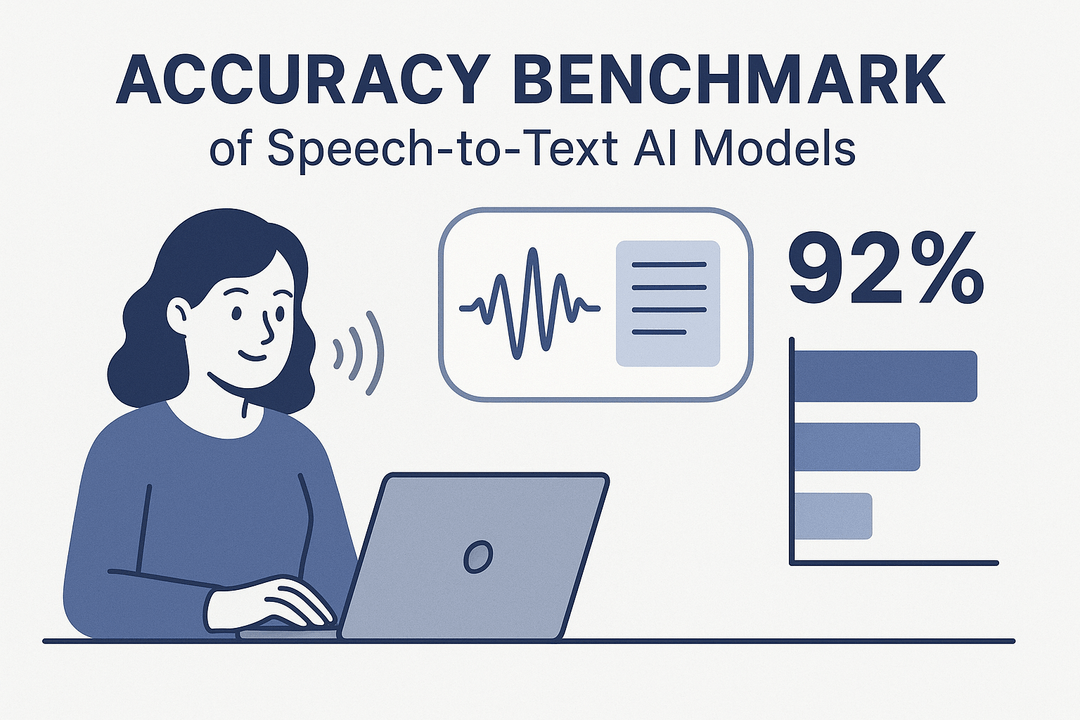
Which Speech-to-Text Is Most Accurate in 2026? A Complete Comparison

Eric King
Author
Introduction: Why Speech-to-Text Accuracy Matters
Accuracy is the single most important factor when choosing a speech-to-text (STT) solution. Whether you're transcribing podcasts, meetings, phone calls, or YouTube videos, even small errors can:
- Change the meaning of sentences
- Require hours of manual correction
- Reduce trust in automated workflows
In this article, we answer a common question:
Which speech-to-text AI is the most accurate in 2026?
We compare leading transcription engines using real-world criteria, not marketing claims.
How Speech-to-Text Accuracy Is Measured
Most vendors use Word Error Rate (WER):
WER = (Substitutions + Deletions + Insertions) / Total Words
Lower WER = higher accuracy.
However, accuracy in practice depends on more than just WER.
Key Factors That Affect Accuracy
- Audio quality
- Accents and dialects
- Background noise
- Domain-specific vocabulary
- Multiple speakers
- Audio length
Top Speech-to-Text Engines Compared
1️⃣ OpenAI Whisper (Large / Large-v3)
Overall Accuracy: ⭐⭐⭐⭐⭐
Best for: Long-form audio, podcasts, multilingual content
Best for: Long-form audio, podcasts, multilingual content
Strengths:
- Extremely strong at accents and non-native speech
- Excellent multilingual support
- Handles noisy audio better than most competitors
- Open-source and transparent
Weaknesses:
- Higher compute cost
- Not real-time by default
- Requires channel splitting for dual-channel calls
Verdict:
Whisper is widely regarded as the most accurate speech-to-text model overall, especially for long recordings and diverse speakers.
Whisper is widely regarded as the most accurate speech-to-text model overall, especially for long recordings and diverse speakers.
2️⃣ Google Speech-to-Text
Overall Accuracy: ⭐⭐⭐⭐☆
Best for: Clean audio, enterprise integrations
Best for: Clean audio, enterprise integrations
Strengths:
- Strong accuracy for US English
- Fast processing
- Good real-time streaming support
- Domain adaptation via phrase hints
Weaknesses:
- Accuracy drops with accents
- Pricing complexity
- Less transparent model behavior
Verdict:
Google STT performs very well on clean, scripted audio but struggles more with global accents compared to Whisper.
Google STT performs very well on clean, scripted audio but struggles more with global accents compared to Whisper.
3️⃣ Deepgram (Nova / Nova-2)
Overall Accuracy: ⭐⭐⭐⭐☆
Best for: Call transcription, real-time use cases
Best for: Call transcription, real-time use cases
Strengths:
- Excellent real-time accuracy
- Strong performance on phone calls
- Native dual-channel support
- Low latency
Weaknesses:
- Weaker multilingual support than Whisper
- Accuracy varies by domain
Verdict:
Deepgram is one of the most accurate real-time speech-to-text engines, especially for calls and live audio.
Deepgram is one of the most accurate real-time speech-to-text engines, especially for calls and live audio.
4️⃣ AssemblyAI
Overall Accuracy: ⭐⭐⭐⭐
Best for: Structured audio, meetings
Best for: Structured audio, meetings
Strengths:
- Good punctuation and formatting
- Built-in summarization and topic detection
- Strong diarization
Weaknesses:
- Less accurate on noisy audio
- Higher cost at scale
Verdict:
AssemblyAI offers solid accuracy with rich features, but raw transcription quality slightly trails Whisper and Deepgram.
AssemblyAI offers solid accuracy with rich features, but raw transcription quality slightly trails Whisper and Deepgram.
5️⃣ Amazon Transcribe
Overall Accuracy: ⭐⭐⭐
Best for: AWS-native workflows
Best for: AWS-native workflows
Strengths:
- Easy AWS integration
- Supports custom vocabularies
- Stable and scalable
Weaknesses:
- Struggles with accents
- Lower accuracy on conversational speech
Verdict:
Reliable for enterprise pipelines, but not the most accurate option in 2026.
Reliable for enterprise pipelines, but not the most accurate option in 2026.
Accuracy Comparison Table
| Engine | Clean Audio | Accents | Noisy Audio | Long Audio | Overall Accuracy |
|---|---|---|---|---|---|
| Whisper (Large) | ⭐⭐⭐⭐⭐ | ⭐⭐⭐⭐⭐ | ⭐⭐⭐⭐☆ | ⭐⭐⭐⭐⭐ | ⭐⭐⭐⭐⭐ |
| Deepgram | ⭐⭐⭐⭐☆ | ⭐⭐⭐⭐ | ⭐⭐⭐⭐ | ⭐⭐⭐⭐ | ⭐⭐⭐⭐☆ |
| Google STT | ⭐⭐⭐⭐⭐ | ⭐⭐⭐ | ⭐⭐⭐ | ⭐⭐⭐⭐ | ⭐⭐⭐⭐ |
| AssemblyAI | ⭐⭐⭐⭐ | ⭐⭐⭐⭐ | ⭐⭐⭐ | ⭐⭐⭐⭐ | ⭐⭐⭐⭐ |
| Amazon Transcribe | ⭐⭐⭐⭐ | ⭐⭐☆ | ⭐⭐⭐ | ⭐⭐⭐ | ⭐⭐⭐ |
Which Speech-to-Text Is the Most Accurate?
✅ Best Overall Accuracy
Whisper (Large / Large-v3)
Especially strong for:
- Podcasts
- YouTube videos
- Long interviews
- Multilingual audio
✅ Best Real-Time Accuracy
Deepgram
Ideal for:
- Call centers
- Live captions
- Voice bots
✅ Best Enterprise Integration
Google Speech-to-Text
Great for:
- Clean audio
- Existing Google Cloud users
Accuracy vs Cost: A Practical Note
The most accurate solution isn't always the cheapest.
Many modern platforms (including SayToWords) use Whisper-based pipelines combined with:
- Audio chunking
- Noise normalization
- Language detection
- Post-processing correction
This approach delivers near state-of-the-art accuracy at a lower cost.
Final Thoughts
If accuracy is your top priority in 2026:
- Choose Whisper for long-form and multilingual transcription
- Choose Deepgram for real-time and call audio
- Avoid treating all audio the same — preprocessing matters as much as the model
The best speech-to-text accuracy comes from the right model + the right pipeline.